Supported by checked research
We use this label when published research directly supports the point being made.

The science behind VIP+ · Research and honest limits
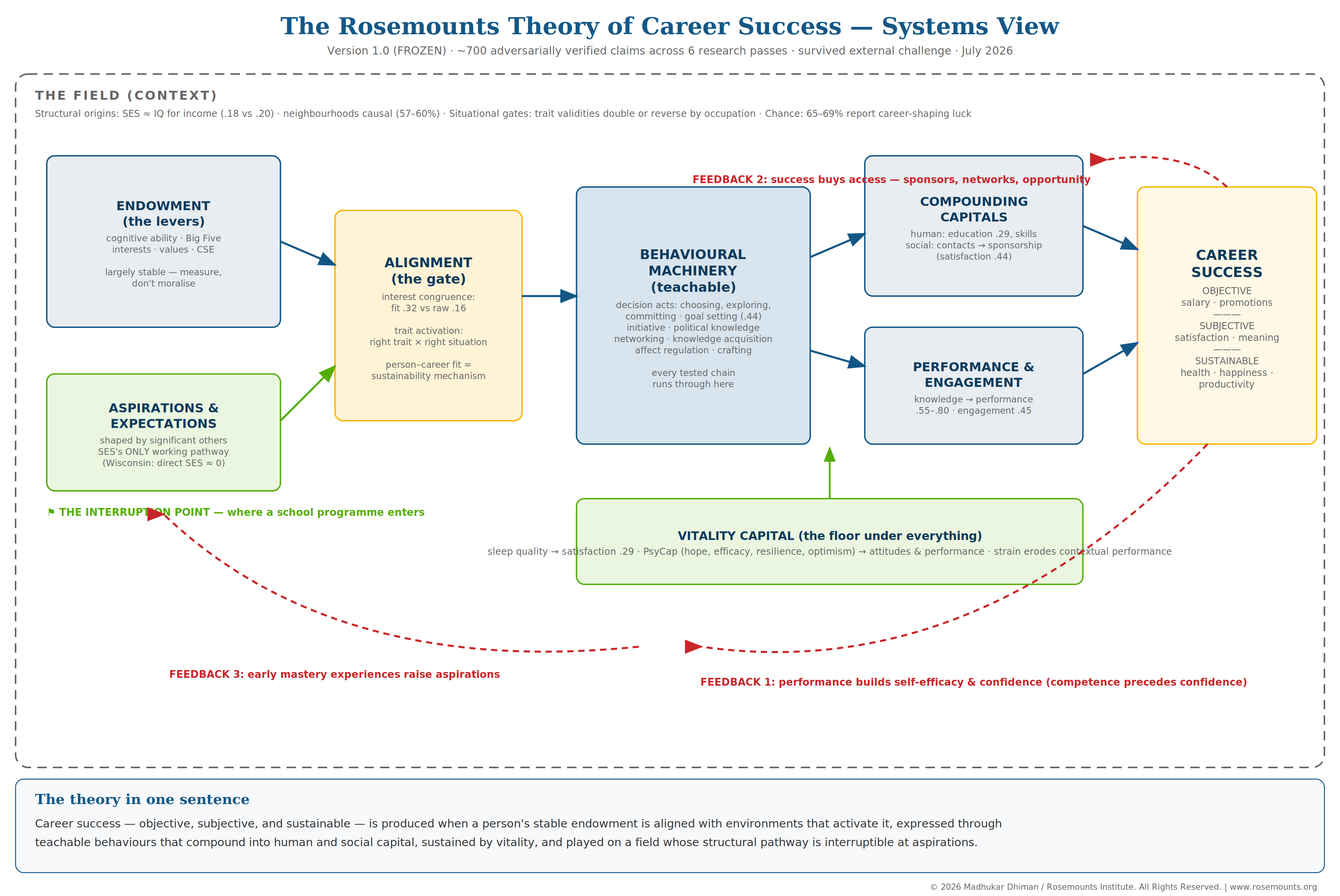
Rosemounts uses published research to guide how we understand students and discuss career choices. The research also sets clear limits: no assessment can promise one perfect career, admission, marks, employment or salary.
We separate what research supports from what Rosemounts is still studying.
Three clear evidence labels
A developing idea should not sound like an established finding.
We use this label when published research directly supports the point being made.
Research supports the idea, but we do not yet have enough evidence to make a stronger claim about the Rosemounts application.
We use this label when the answer is not yet settled and more evidence is needed.
Four findings that shape the approach
The findings help us ask better questions. They do not produce one correct career answer.
Marks, salary or status do not tell us whether a person finds the work satisfying. Both external results and the person’s experience matter.
An interest score becomes more useful when we compare it with the activities and settings in which the person may study or work.
A counsellor helps the student understand the information, check assumptions and connect it with a real decision.
Health, happiness and useful work can change over time. A career is not one title chosen forever.
From score to meaning
A score becomes useful when it is read with the other lenses, academics, the student's situation and the decision ahead.
Values, Interests, Personality and Skills answer different questions. Read each one clearly first.
Where the lenses agree, an idea may be worth exploring. Where they differ, the student may need more thought or experience.
Grade, board, subjects, academics, family, opportunities, parents, teachers and the student’s own words all add context.
A conversation, course, project or guided experience gives the student new evidence. The plan can then be reviewed.
Our honest limits
People change. Opportunities change. No assessment can measure every part of a life.
Explore the Career GardenThe full paper
The full paper explains the research, open questions and ideas that did not pass our checks. It is 33 pages and requires no form.
Download the paper (PDF, 33 pages)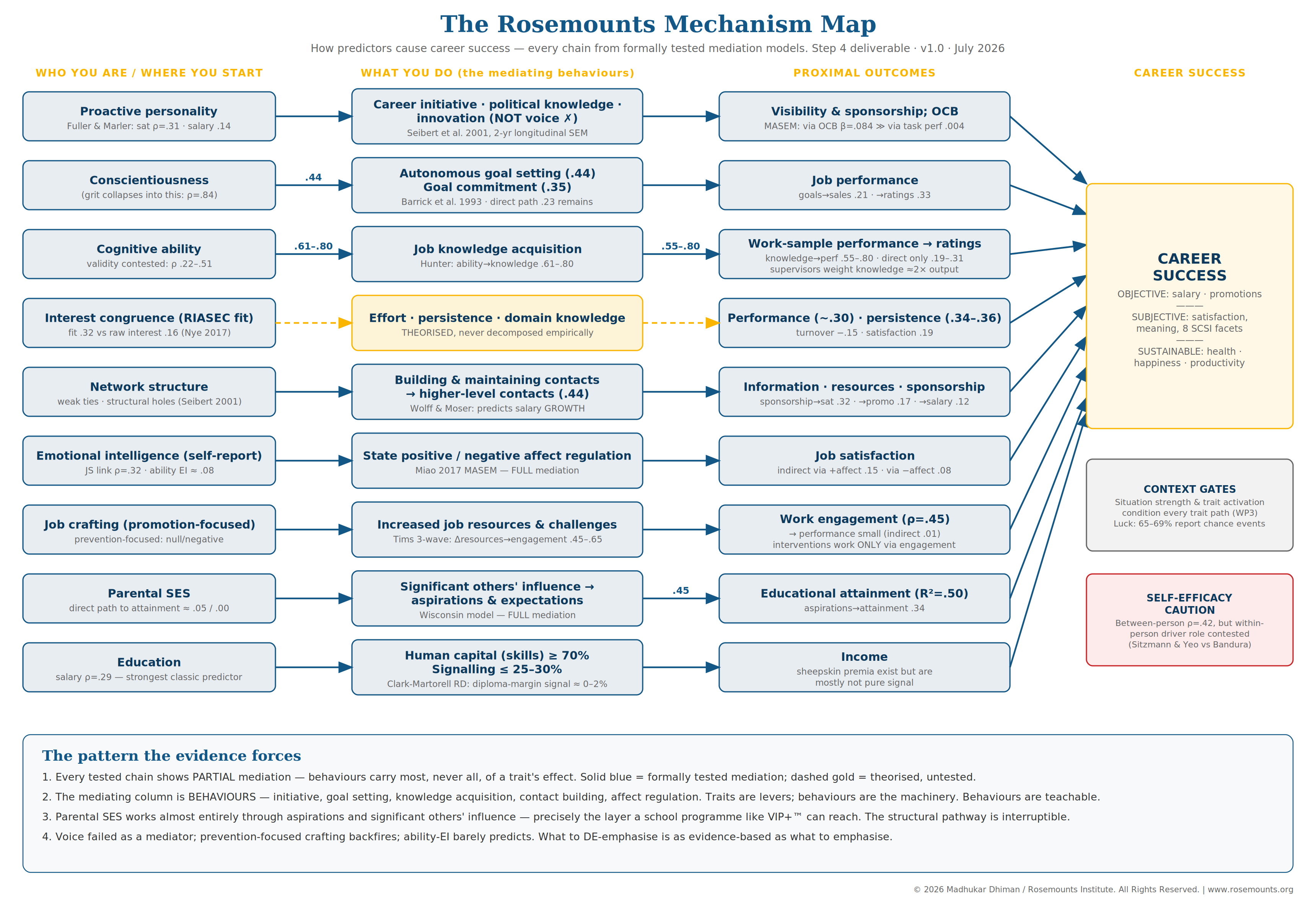
Selected research
This is a short reading list, not the complete Rosemounts research corpus.
Ng, T. W. H., Eby, L. T., Sorensen, K. L., & Feldman, D. C. (2005). Predictors of objective and subjective career success: A meta-analysis. Personnel Psychology, 58(2), 367–408.
Open the published sourceNye, C. D., Su, R., Rounds, J., & Drasgow, F. (2017). Interest congruence and performance: Revisiting recent meta-analytic findings. Journal of Vocational Behavior, 98, 138–151.
Open the published sourceWhiston, S. C., Li, Y., Goodrich Mitts, N., & Wright, L. (2017). Effectiveness of career choice interventions: A meta-analytic replication and extension. Journal of Vocational Behavior, 100, 175–184.
Open the published sourceDe Vos, A., Van der Heijden, B. I. J. M., & Akkermans, J. (2020). Sustainable careers: Towards a conceptual model. Journal of Vocational Behavior, 117, 103196.
Open the published sourceWhere this page fits
You do not need to read every page. Choose the next page that answers your question.
Compare subjects, courses, colleges and career options through a personal guidance process.
Open this page Across IndiaMeet a counsellor online and connect the decision in front of you with useful evidence and next actions.
Open this page Start hereUse a short Discovery Assessment or find the guided pathway that fits the decision.
Open this page Grades 9–12Bring academics, the student’s voice, assessments, parents, teachers and real options together.
Open this page University studentsCompare courses, internships, higher studies and first-career directions through a university-stage process.
Open this page ProfessionalsUnderstand whether the role, workplace or direction needs to change before making a major move.
Open this page After assessmentTurn ideas into projects, experiences, useful skills and evidence the student can explain.
Open this pageQuestions about the evidence
No. Research supports particular ideas used in the approach, including the importance of fit, context and guided career interventions. It does not prove that the complete Career Garden model guarantees admission, employment, salary or any other future outcome.
Values, Interests, Personality and Skills describe different parts of the student’s present pattern. Reading them together reduces the risk of letting one score dominate an important decision.
They can show meaningful patterns, but interpretation should remain developmental and contextual—especially for young people. Exposure, learning, changing circumstances and experience can alter how a pattern is expressed.
The counsellor checks context, helps the student understand agreements and tensions across the evidence, tests assumptions and turns the interpretation into a realistic next step. Technology supports this work; it does not replace it.
Rosemounts is building longitudinal evidence about how patterns and decisions develop across school years and how guided skills and experiences may improve decision quality. Those questions remain frontier work until the data supports stronger conclusions.
Evidence becomes useful in context
A counsellor can explain which assessment pathway fits the decision and how the resulting evidence would be interpreted.
Send an enquiryinfo@rosemounts.org